

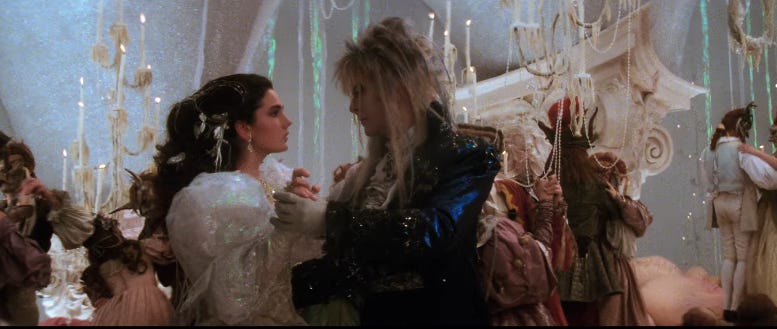
The thing about the 1986 puppet fantasia Labyrinth is, you could easily dismiss it as a girl learning to finally share her toys in a fluffy kids picture that never raises the stakes enough for true danger to rear its head.
But Labyrinth has become a cult classic for a multitude of reasons. In an age where creativity has rapidly been swallowed by CGI, green screens, and now AI, it has a handmade care which has all but vanished from filmmaking. But in the 80s, George Lucas and Jim Henson could collaborate without massive global corporate beasts getting involved, and family fare could have a certain grittiness, even sexual under (or even over!) tones, and Jennifer Connelly was as yet mostly undiscovered.
It’s not like women weren’t a presence in 80s pop culture. A few years prior Kathleen Turner got dowdy and dirty before being molded into a sexual adventurer in Romancing the Stone, Linda Hamilton came into her own as the mother of human resistance itself in The Terminator, Sigourney Weaver fought otherworldly threats in Aliens the same year, Elisabeth Shue would play a teenage girl who quickly finds herself in over her head in the big bad city of Chicago in Adventures In Babysitting, and Return to Oz proved that nightmare fuel and family viewing could actually mix the year prior.
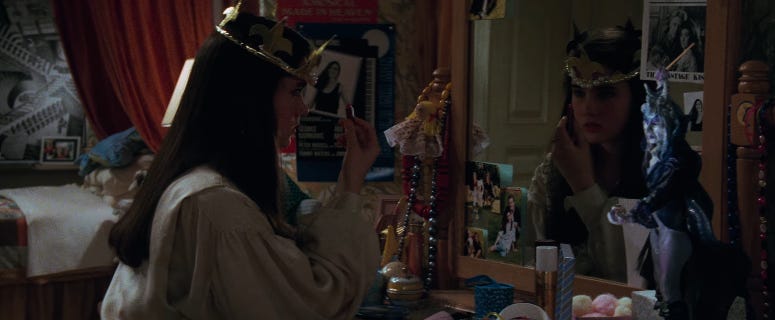
But Labyrinth has a truly unique place, centering around a teenage girl in a fantasy setting who is coming into her own and basically fighting her way out of a toxic relationship. Or from the start of one. Whatever. The movie wears its inspirations on its sleeve, visually shouting out Maurice Sendak’s Where the Wild Things Are, The Wizard of Oz, Snow White, and Grimm’s Fairy Tales as the camera pans across the various debris in Sarah’s bedroom. She’s played by the aforementioned Jennifer Connelly, and it was this role that took her career to a level actors build secret award acceptance speeches on.
It’s the kind of performance that makes it impossible to imagine anyone else in the role, and practically every established and emerging actress fought for it. Helena Bonham Carter, Jane Krakowski, Sarah Jessica Parker, Mary Stewart Masterson, Laura Dern, Lili Taylor, Laura San Giacomo, Ally Sheedy, and Mia Sara all auditioned, but it was Connelly who won out, and it is she who perfectly embodies a certain teenage girl state, one on the verge of young adulthood but still firmly in childhood’s grasp.
Sarah begins deeply resentful of the fact that she’s tasked with looking after her baby brother Toby (Toby Froud) while her father and stepmother head out for the night, bemoaning what she perceives as her persecuted state in her insatiable appetite for drama. It’s the most dramatic and cringe in a way we all remember, and culminates in her wishing that the Goblin King (David Bowie, RIP) would take Toby away. And much to her shock and regret, her request is immediately fulfilled. Refusing to leave her brother to his fate to transform into a goblin, Sarah journeys into the fantastical world to solve the labyrinth and save Toby.
Cue the musical numbers! David Bowie and that codpiece! And the puppetry! Oh, the puppetry. The various creatures are immaculately rendered and emotive, with eyes that seem to fill with humor, anxiety, and even crushing disappointment. In other words, it’s Jim Henson giving all the magic he’s renowned for, and after all the darkness and danger of his previous film The Dark Crystal, he was clearly determined to keep it light for what would be his final directorial feature.
It certainly went through a number of metamorphoses before it became the beloved staple of cinematic history. There were numerous rewrites, arguments about the movie’s creative direction, and the songs. The version we all know has become so familiar that it may be hard to understand at times why some of the critical reception was tepid. Ebert can be given the benefit of the doubt for claiming that the film was missing something that prevented it from truly coming alive, but for others, the stench of sexism is strong on criticisms of the film and Connelly’s portrayal of Sarah.
It’s not exactly surprising, since Labyrinth directly undercuts so much of the romanticism of the fairy tales it’s built upon. While gallantry is embodied by the very platonic and rather bumbling Sir Didymus, who joins Sarah, her reluctant guide Hoggle, and loyal beast Ludo, David Bowie’s Jareth is romantic toxicity personified, all sex appeal and attempting to bully Sarah into obedience and submission. In the final battle, his minions are armored as knights, usually the ultimate symbols of chivalry.
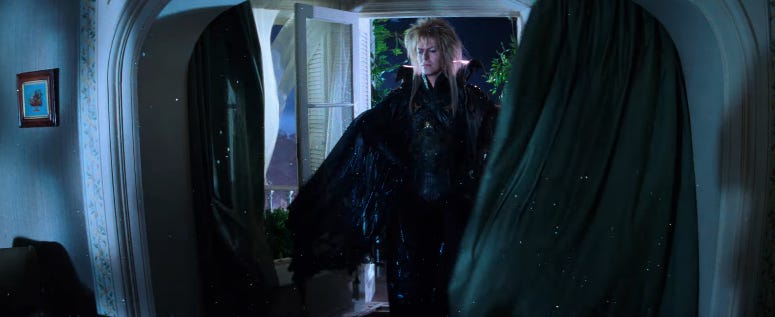
No doubt the uncredited work of writers Laura Phillips and Elaine May helped add a particular kind of venom to Jareth’s gaslighting techniques, from the unsettling ballroom dance to his romantic overtures that reek of entitled manipulation. When he senses Sarah is about to win at their climactic confrontation, he deplores how ungrateful he is for everything he’s allegedly done for her, and how little he’s supposedly asking in return.
“Just let me rule you, and you can have everything you want,” Jareth pleads. “Just fear me, love me, do as I say, and I will be your slave.” Quite a way for things to come to a head in the middle of fabulous musical numbers like “Magic Dance” and “As the World Falls Down.” Sarah’s response that vanquishes him is everything. When she exclaims, “You have no power over me!” she gets her brother back, and she gets to keep and call on the magic she’s discovered.
When Labyrinth ends as Sarah happily celebrates with Hoggle and her other friends in her bedroom, it is a showcase of what Henson built his brand on, the magic of childhood lingering into adulthood, allowing us to see a world that often seems cold and uncaring with a brighter, more optimistic gaze.